
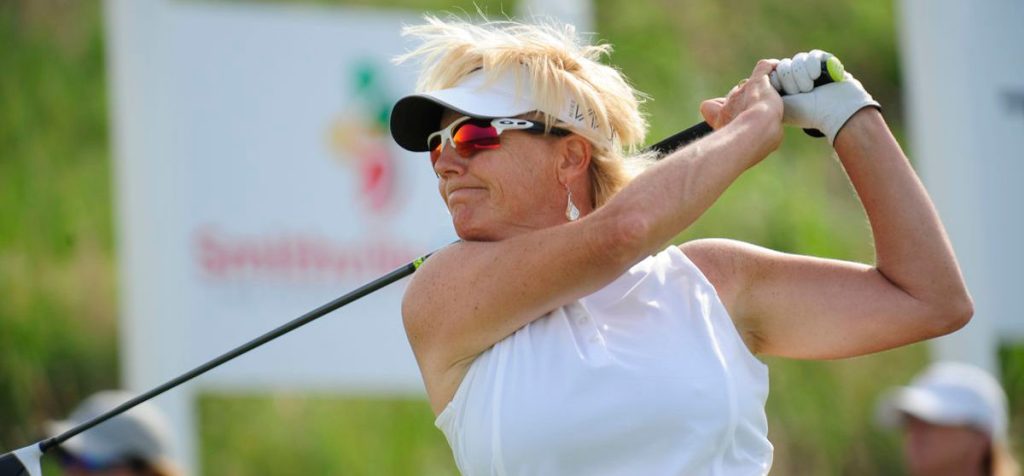
This installment of “In Their Words,” golfer Kathryn Imrie is interviewed by JJ Weber (Co-Founder and Director of Sports Psychology).
Kathryn competed on the LPGA Tour and Ladies European Tour for 18 years. Kathryn attended the University of Arizona, where she earned All-America honors. In 1995, Kathryn became the first Scottish golfer to win on the LPGA Tour. In addition, Kathryn carded a record 11 birdies during a round at the 1997 State Farm Rail Classic, shooting 62 to equal the LPGA scoring mark.
However, Kathryn is more than a golfer; she is an advocate for women’s sports and serves as an inspiration for all.
 In the interview, Kathyn offers a candid look into the realities of turning pro, the pressure of sustaining a career on tour, and the often-overlooked mental health challenges that come with elite performance. Kathryn also speaks with clarity and conviction on issues like the disparity in prize money and the need for stronger advocacy for women’s sports.
JJW: What is it like to handle the pressure on the Tour? In college, you were elite, and suddenly you’re a professional and everyone is elite. What was it like to be in that position?
Kathryn: That was a real awakening. It’s something that needs to be taught better or forewarned. One week, I was an amateur superstar, and then all of a sudden, I became the newbie professional who no one knew and no one really cared about.
That was a hard learning curve for me. I know you’re in it for yourself and no one else. That’s part and parcel. But no one told me that would happen. It’s as if no one taught me to understand that.
If you’re coached about transitioning into the pro ranks, you’d be better prepared for it.

JJW: How was life on the tour?
Kathryn: Playing on the European Tour my first few years was fun. I was playing well, and there’s obviously a strong correlation between performance and your enjoyment.
I wasn’t from a family that had enough wealth to travel with me all the time, but I did have good sponsorships. However, when I started on the Tour, I was pretty much left to my own devices. I didn’t have a management company, so I had to make my own travel plans.
As far as making arrangements and tour life goes, I just learned by doing. We had a fact sheet back then with phone numbers and information for the following tournament. All of us golfers travelled as a group. You travelled and bunked with your friends. It made it a bit easier, but it’s a very different lifestyle.
When I teach golfers, I know there will be some players who are cut out for it and some who are absolutely not.
JJW: How is the pressure of dealing with a lack of financial stability?
Kathryn: That’s a great question. It’s a question I’m frequently asked. You worry about finances because they are performance-related. I was lucky enough to have good sponsorship. My sponsorship included a company credit card that covered my expenses. I also had an equipment company that would double my money when I won on the tour.
Nowadays, deals are very different. Deals today go to the superstar golfer, not the journeyman pro, which I was. Although I had my moments of greatness, I never ranked number one or in the top ten. I think the highest ranking I achieved was 30, which is obviously good. If you finish in the top, you’re set; you don’t have to worry financially. For me, I needed to stay in the top 90, so I could maintain my playing rights for the following year. So, that was more of a worry. It’s more like, “Can I sustain this? Will I still have a job next year?”
What do you think about the disparity of prize money between men and women?
Kathryn: It’s crazy. Back then, the men roughly earned five times as much, if not six times as much, as the LPGA. And guess what? It’s the same today; even though we’re playing for more money, the vast difference in prize money remains.
I think it ultimately comes down to the TV rights and the number of viewers. However, it’s how you build and promote women’s golf. In South Korea, they produce great golfers because their players are promoted. It’s like the ‘if they build it, they will come’ type of thing.
These young women work extremely hard, as hard as the men. And we are paid nowhere near the same as the men. We are playing for good money, don’t get me wrong, but the money difference is vast. When you peel back the onion, the money disparity is because people don’t promote women’s golf as well. Clearly, people won’t watch it if it’s not promoted.
JJW: How do you change that culture, though?
Kathryn: I think we need more than just the women’s voices standing up for women. It’s not just a female issue. That’s the problem for me. It’s not enough. Men should speak up and support the women’s game as well.
JJW: What are your thoughts about the mental game of golf and mental health on the Tour?
Kathryn: It’s a huge part of the game, especially in a game like golf, where you have so much downtime during a round. I mean, you literally play 30 minutes out of the five hours you’re on the course. So, there is a lot of time when your mind can wander. It’s a bit unique in that way.
Additionally, there are definitely a lot more mental health issues than people are aware of. There’s Pak Se-Ri, who played 25-30 years ago. She took the LPGA by storm and was so much better than everyone else. Towards the end of her career, she spent time in a hospital for mental exhaustion and burnout. Now, she has a place in Korea, where she works with young women to promote work-life balance.
I think it’s just the pressure to perform, I’ve seen it at the college level where top women experienced pressure since they were young. As soon as they become freshmen in college, it’s a shock. There’s another life. Some recognize it right away, while others don’t. It’s just getting that balanced right. Sports are a great way to earn a living, but not at the cost of your relationships or mental health.
JJW: What advice would you give your younger self? What would you do differently?
Kathryn: The advice I would give to myself is not to be so hard on yourself. It’s just a game at the end of the day. Yes, it’s your job. However, you are a person who happens to play golf. It should not be the be-all, end-all. I would tell myself to have a better work-life balance.
Even during tournament weeks, you have a lot of downtime. You usually arrive at the tournament on Monday, but don’t play until Thursday. So, during that downtime, you should try visiting the Eiffel Tower, see a statue, or do something that’s typically a tourist attraction.

When I played, I’d come off the course and my head would be absolutely splitting. I was so intensely focused that I would get migraines. There are ways to stay focused without breaking your brain and having these headaches hamper your performance.
And then there is mental exercise. I was pretty good about a mental exercise program halfway through my career. When I performed mental exercises, I did well and achieved a lot of my goals. I wish I’d started that as a daily routine earlier in my career, just in some form of meditation or relaxation.
Another thing would be acceptance. I wish I had told myself, “You’re such a great golfer. What has gotten you to the Tour is good enough to sustain and keep you here. You don’t have to continually worry that you have to change or freak out about getting better.”
JJW: Do you have any advice for coaches and parents?
Kathryn: I see it so much in the golf world from parents, “My kid is gonna be the next Tiger Woods, the next Michelle Wie. So we are gonna dedicate everything to golf.” Every time I hear it, I’m like, “Don’t do it!”
For parents, the best advice I can give them is to let their kids have fun. Have them play other sports too, like tennis. Some say the tennis swing will ruin their golf swing. That’s rubbish! I think when you only play golf from a young age, you’re straining the same muscles. By training those same muscles over time, they’re going to break down, just like what happened to Tiger Woods. Most people don’t realize that, despite how he trained when he was young, who knows, Tiger would probably still have succeeded. That’s not talked about enough.
JJW: So, what are you up to now?
Kathryn: Currently, I’m back in my hometown in Scotland, where I’m teaching a junior program at one of my local clubs. Can’t get away from the coaching. I’m actually going to play a little bit more senior women’s golf.
I’m getting back into golf fitness, which includes a mental program, by the way. July and August will be my busy time. So I’m in the middle of getting ready for that now.
I am also based in California, where I teach part-time at a local club. I love teaching. I love coaching. It’s always going to be my blood, and I’m going to do that until my dying day.

At Player Support Services, we know that every athlete’s journey is filled with defining moments—the triumphs, the setbacks, the doubts, and the growth that comes from navigating them all. Kathryn Imrie’s story reminds us that success in sport isn’t just measured by wins and records, but also by resilience, balance, and the ability to stay grounded through it all.
Our role is to walk alongside athletes on that journey—whether it’s providing performance psychology, guidance through transitions, support for emotional well-being, or tools to prepare for life beyond competition.
No one succeeds alone. That is why PSS is fully committed to supporting athletes, families, and organizations with discreet, tailored care that helps athletes not just perform, but truly thrive.
At Player Support Services, we partner with clubs, federations, academies, and agencies to ensure that athletes receive support throughout every stage of their careers.
 For more information about Player Support Services or to schedule a meeting, email JJ Weber, M.Ed. (joe@player-support.com)
JJ is a Co-Founder of Player Support Services and a sports psychology specialist with 20 years of experience working with professional and Olympic athletes worldwide. JJ focuses on athletic peak performance, injury recovery, and holistic well-being on and off the field.